

You are sitting at your desk. Your heart is racing. You look at your NCERT books. Then you look at the clock. The same question keeps spinning in your head:
“Will I pass CBSE Class 12 board exams?”
I get it. I am a teacher at Khaitan Public School (KPS). Every spring, I see this look on students’ faces. It is a mix of fear, tiredness, and “I just want this to be over.”
If you are losing sleep, you are not alone. But here is the good news: Passing is a science, not a mystery. In this guide, I will break down the math, the rules, and the secrets we use at KPS to make sure you cross the finish line.
No big words. No confusing jargon. Just the facts you need to breathe again.
The Big Numbers: What Are Your CBSE Class 12 Exam Result Chances?
Most students think they need to be a genius to pass. You don’t. You just need to understand how the system works. The CBSE actually wants you to pass. They design papers so that a student who knows the basics can get through.
Statistics: The Reality of Passing
Let’s look at the numbers. They don’t lie. For the 2024–25 session, nearly 17.88 lakh students registered. That is a huge number! But look at how many actually pass.
| Examination Year | Overall Pass % | Girls Pass % | Boys Pass % | Total Students Passed |
| 2021 | 99.37% | 99.67% | 99.13% | 12,96,318 |
| 2022 | 92.71% | 94.54% | 91.25% | 13,30,000 |
| 2023 | 87.33% | 90.68% | 84.67% | 14,50,174 |
| 2024 | 87.98% | 91.52% | 85.12% | 14,26,420 |
| 2025 (Latest) | 88.39% | 91.64% | 85.70% | 14,96,307 |
What does this mean for you? Nearly 9 out of 10 students pass. The “pass prediction” for a regular student is very high. If you are showing up and writing the paper, you are already in the majority.
CBSE Class 12 Passing Criteria: Doing the Math
To answer “Can I pass CBSE 12th board exams?”, you have to know the 33% rule. In Class 12, it is a bit tricky. You can’t just get a total of 33. You have to pass Theory and Practical separately.
The Passing Formulas
If you are in the Science Stream (Physics, Chemistry, Biology):
Theory (70 marks): $70 \times 0.33 = 23.1$ (You need 23 marks)
Practical (30 marks): $30 \times 0.33 = 9.9$ (You need 10 marks)
If you are in Commerce or Humanities (Accounts, Economics, English):
Theory (80 marks): $80 \times 0.33 = 26.4$ (You need 26 marks)
Internal (20 marks): $20 \times 0.33 = 6.6$ (You need 7 marks)
The “RT” and “RP” Trap
RT (Repeat in Theory): You passed practicals but failed theory.
RP (Repeat in Practical): You passed theory but failed practicals.
You must pass both to get that “Pass” certificate.
Why Do Students Worry?
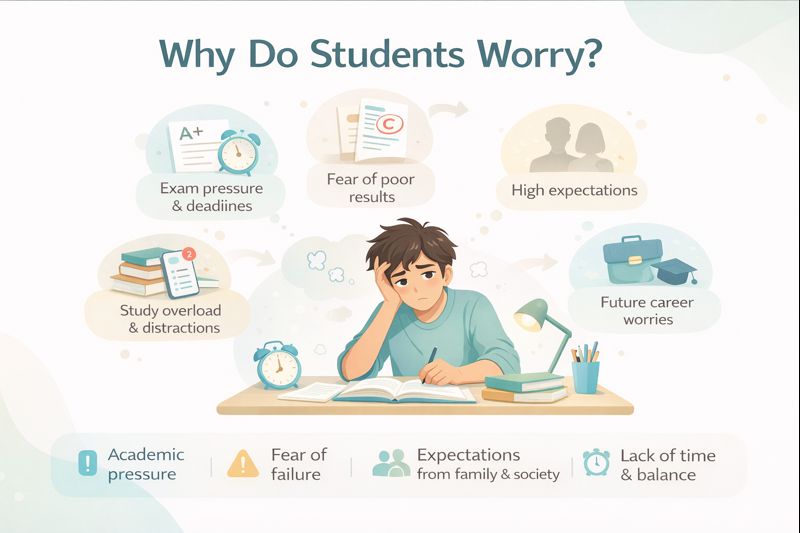
What keeps you up at night?
Disappointing your parents?
Your friends moving to college while you stay behind?
The “Career Uncertainty” after 12th?
The cost of not acting is high. If you don’t focus now, you might have to give a “Compartment Exam” in July. While your friends are enjoying their summer break, you will be back in the classroom.
The most annoying thing about current advice:
People tell you to “Study 18 hours.” That is bad advice. At Khaitan Public School, we teach students to use Mindfulness.
Research shows that 75% of Class 12 students are sleep-deprived. 1 in 5 students rarely feel “peaceful.” This stress actually makes your brain work slower!
The Invisible Safety Net: Grace Marks and Moderation
Many students ask: “Will the board help me if I’m failing by 1 or 2 marks?”
The answer is Yes.
1. Grace Marks
If you are a “Borderline” student (failing by 1 to 5 marks), the board often gives you grace marks.
But there are rules:
You must have tried to answer the questions. (No blank sheets!)
It usually only applies if you are failing in just one or two subjects.
2. Moderation Policy
If your set of the question paper was much harder than another set, the CBSE scales the marks. They can adjust marks by up to 15 to make things fair. This is why you shouldn’t panic if your paper feels “tougher” than your friend’s.
Subject-Wise High-Yield Strategies
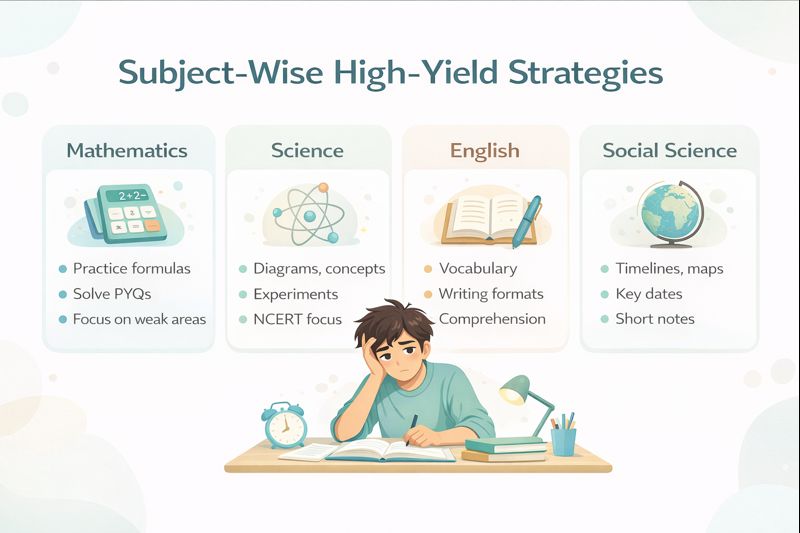
At Khaitan Public School, we tell students: Don’t study everything. Study what matters.
Physics (Science)
Focus on Optics and EM Waves. These two units alone are worth 18 marks. If you add Electronic Devices (7 marks), you have 25 marks. You’ve already passed the theory!
Chemistry (Science)
Electrochemistry is the king with 9 marks. If you hate Organic Chemistry, master the Physical Chemistry units (Solutions, Kinetics) to secure your 23 marks quickly.
Economics (Commerce/Arts)
Focus on Indian Economic Development. It is 40 marks and mostly involves reading and understanding stories about the economy. The unit “Current Challenges Facing Indian Economy” is worth 20 marks. Master that, and you are almost there!
How to Write Like a Topper (Even if You Aren’t One)
Board examiners have to check hundreds of copies. They are tired. If you make their job easy, they give you more marks.
Use Bullet Points: Never write long paragraphs.
Highlight Keywords: Underline the main words.
The 15-Minute Rule: Use the reading time to pick the easiest questions first.
Step Marking: In Math, even if the final answer is wrong, you get marks for the steps. Never leave a question blank!
| Strategy | Impact | Why? |
| Draw Diagrams | High | Shows you understand the concept visually. |
| Bullet Points | High | Makes it easy for the examiner to find the answer. |
| Underlining | Medium | Directs the eye to the correct technical terms. |
Advantages and Disadvantages of the CBSE System
Advantages
Predictability: The NCERT is your bible. 90% comes from there.
Step Marking: You get points for effort.
Multiple Chances: The Compartment system gives you three chances to clear a failed subject.
Disadvantages
High Pressure: One month decides your college entrance.
Competency Shift: CBSE is moving toward “Case Studies.” Rote learning (cramming) doesn’t work as well anymore.
Regional Differences: Statistics show regions like Vijayawada have a 99% pass rate, while Prayagraj is around 79%. Your environment matters!
The Khaitan Public School Philosophy
At KPS, we believe “Curiosity meets capability.” We don’t just want you to pass; we want you to be a thinker.
We use tools like:
Box Breathing: To calm down before the exam.
The 5-4-3-2-1 Method: To stop a panic attack in the exam hall.
Transformative Sessions: To build confidence.
What If the Worst Happens? (The Safety Net)
If you fail in one subject, you aren’t “a failure.” You are just in the Compartment Category.
July Exam: You can retake that one subject just two months later.
Practical Marks: If you passed the practical, you don’t have to do it again. Your marks are carried forward.
Final Checklist: Will You Pass?
Do I have 33% in my Internal/Practical marks? (Your school usually ensures this!)
Can I score at least 23 or 26 marks in Theory?
Have I looked at the last 5 years of Previous Year Papers (PYQs)?
Am I focusing on the high-weightage chapters?
If you said YES to these, stop worrying. You are going to pass.
Conclusion: Take the Leap
The question “Will I pass CBSE Class 12 board exams?” has a simple answer: Yes, if you follow the system.
The statistics are on your side (88%+ pass rate). The board is on your side (Grace marks). Your school is on your side.
Don’t let the skeptics tell you it’s impossible. Pick up your pen. Open your NCERT. Start with the easiest chapter today. With the right guidance, structured preparation, and a calm mindset—like students receive at the best CBSE school in Ghaziabad—this goal is absolutely achievable.
You are more than a mark sheet, but that mark sheet is definitely within your reach.
Frequently Asked Questions (FAQs)
1. Can I pass if I start studying 1 month before?
Yes! Focus on high-weightage units (like Optics in Physics or Part B in Economics) and solve PYQs.
2. Do I need to pass theory and practical separately?
Yes. For Class 12, you need 33% in both components individually.
3. What is a “Repeat in Theory” (RT)?
It means you passed your practical exam but didn’t get 33% in the written board paper. You will need to give a compartment exam for that theory paper.
4. How many students pass CBSE 12th on average?
Historically, around 87% to 92% of students pass. In 2025, the rate was 88.39%.