

Hey everyone! Mr. Sharma here, your friendly research teacher from best cbse school in Ghaziabad Khaitan Public School. You know how much I love finding new ways to make learning easier and more fun. And guess what? There’s a new superhero in town, and it’s called AI
Now, don’t let that big word scare you! Think of AI tools as super-smart helpers that can make your schoolwork way, way simpler. Imagine finishing your homework faster, understanding tricky topics better, and even writing amazing essays without all the stress. Sounds good, right?
In 2025, AI is like magic for students. It’s not about doing your work for you, but about giving you superpowers to study smarter, not just harder. If you’ve ever felt stuck on a tough problem or spent hours trying to organize your notes, then this blog post is for you. We’re going to explore the best AI tools for students to study smarter in 2025!
What’s All This Fuss About AI for Students Anyway?
You might be wondering, “What even is AI?” Think of it like a super-brainy computer program that can learn and think almost like a human. It can read tons of books in seconds, find answers to your questions, and even help you create things. Key components of AI include machine learning, which allows AI to learn from data, and natural language processing, which helps AI understand and generate human language.
For students, AI is like having a personal tutor, a super-fast research assistant, and a brilliant editor, all rolled into one. It’s not here to replace your brain, but to give your brain a serious boost!
Here’s why AI is becoming a game-changer for students:
Saves Time: Less time on boring stuff, more time for fun!
Makes Learning Easier: Hard topics become simple to understand.
Boosts Your Grades: When you understand more, you do better.
Helps You Be Creative: AI can help you brainstorm ideas and make cool projects.
Why You NEED to Use AI Tools for Studying (Seriously!)
Let’s be honest, school can be tough. There are so many subjects, so much to remember, and sometimes, it feels like there just aren’t enough hours in the day. This is exactly where AI swoops in to save the day!
Think about what keeps you up at night when it comes to school:
“Oh no, I have a huge essay due tomorrow and I haven’t even started!” (Sound familiar?)
“This math problem makes no sense!” (We’ve all been there.)“How am I ever going to remember all these dates for history class?” (Memorization struggle is real.)
AI tools are designed to tackle these exact problems. They can help you break down complex tasks, get instant explanations, and even create personalized study plans.
What’s the #1 thing you want as a student? To succeed, right? To get good grades, understand what you’re learning, and feel confident. AI helps you do exactly that, but in a much less stressful way.
What annoys you most about current study methods? Probably how long they take, how boring they can be, or how hard it is to find specific information. AI blasts through these annoyances, making studying faster, more engaging, and incredibly efficient.
The Top AI Superheroes for Students in 2025: My Expert Picks!
Alright, let’s get to the good stuff! I’ve researched and tested a bunch of AI tools, and these are my absolute favorites – the ones that will truly help you study smarter in 2025. Some are free, some might have a small cost, but all of them are super powerful.
Here are the best AI tools I recommend for you:
1. Notion AI: Your All-in-One Study Command Center
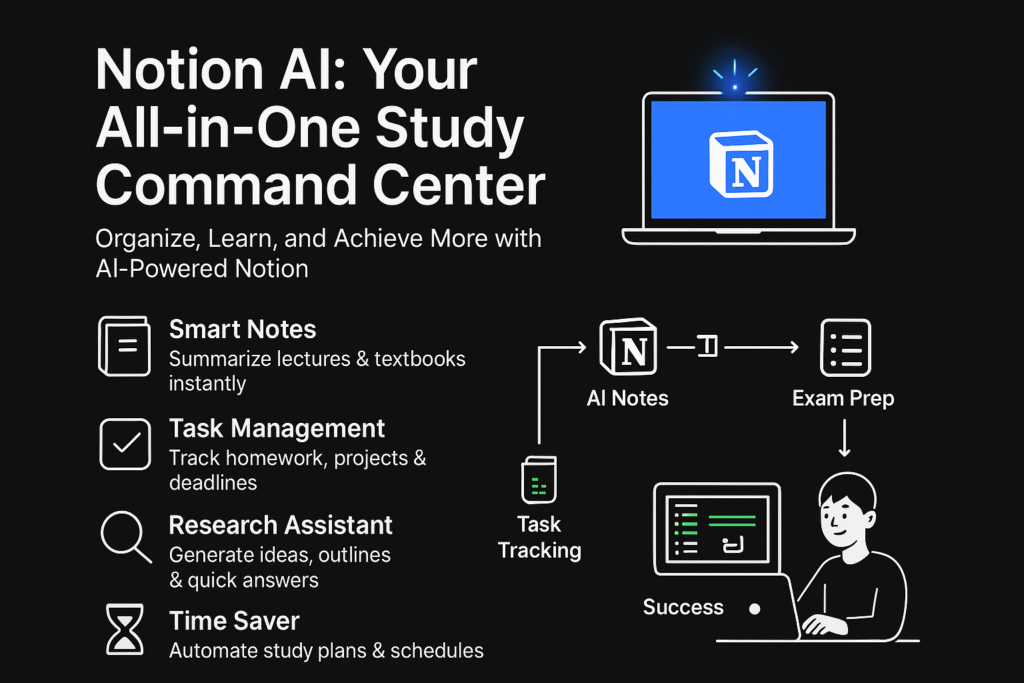
Imagine having one super-notebook where you can write notes, plan projects, organize your entire school life, and have an AI assistant built right in! That’s Notion AI.
What it does:
Note-taking wizard: Helps you organize your thoughts and even summarizes long articles.
Brainstorming buddy: Stuck on an essay idea? Notion AI can give you a bunch of fresh ideas.
Project planner: Keep track of all your assignments and deadlines.
Content creator: Can help you write outlines, drafts, and even correct your grammar.
Advantages:
Super organized: Keeps everything in one place.
Versatile: Good for almost any subject or task.
Boosts creativity: Helps you think of new ideas.
Disadvantages:
Can be a bit much at first: It has so many features, it might take a little time to learn.
Not fully free: While Notion has a free tier, some advanced AI features might require a paid plan.
How it makes you feel: Organized, confident, and ready to tackle any project!
Pricing: An “Education Plus Plan” is available for free to individual students and teachers with a verified educational email. This plan may also make users eligible for 50% off Notion AI features.
2. ChatGPT / Gemini (Google Bard): Your Instant Answer Machines
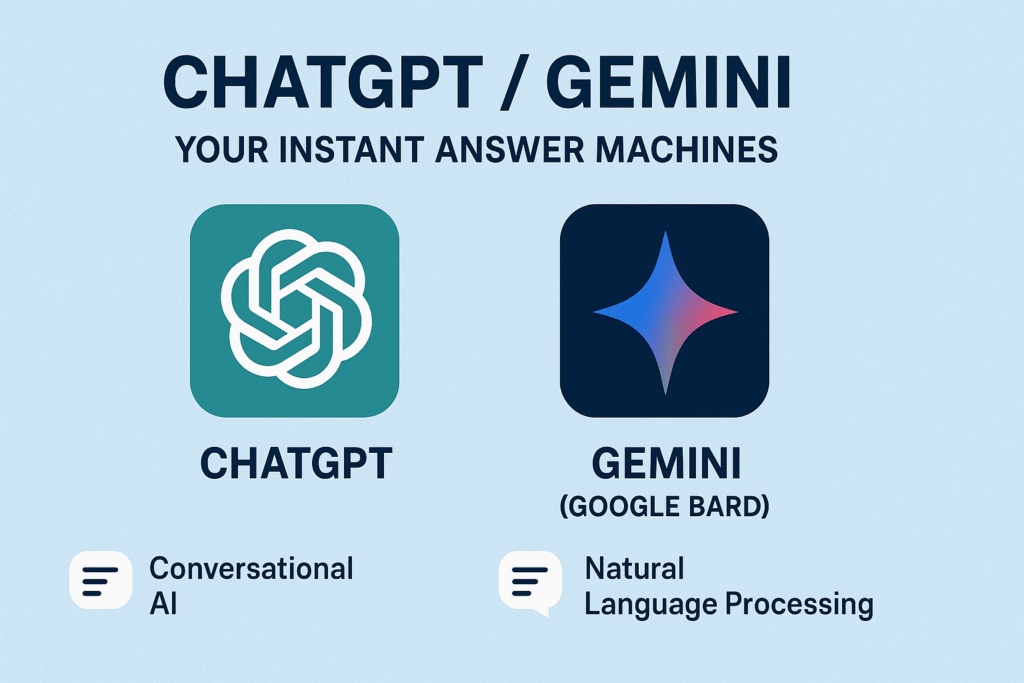
These are like having the smartest person in the world available 24/7 to answer any question you have. ChatGPT and Gemini are examples of “large language models.”
What they do:
Explain anything: Don’t understand a concept? Ask them! They can explain it in simple words.
Brainstorm ideas: Need ideas for a story or a presentation? They’re full of them!
Summarize long texts: Got a huge reading assignment? They can give you the main points in seconds.
Practice foreign languages: Chat with them in another language to improve your skills.
Advantages:
Free (mostly): The basic versions are usually free to use.
Instant answers: No more waiting to ask your teacher or searching through textbooks.
Endless possibilities: You can use them for almost anything.
Disadvantages:
Can sometimes be wrong: Remember, they’re just computers! Always double-check important information.
Not for cheating: They can help you learn, but don’t just copy-paste their answers for homework!
How it makes you feel: Empowered, knowledgeable, and never stuck again!
Pricing: A free version of ChatGPT provides basic access to GPT-3.5 and GPT-4o mini. Paid plans, such as ChatGPT Plus, offer enhanced features and faster response times for $20/month.
3. Grammarly AI: Your Personal Grammar Guru
Do you ever worry about making mistakes in your essays or emails? Grammarly AI is like having a super-smart English teacher looking over your shoulder, but in a good way!
What it does:
Checks your spelling and grammar: Catches all those tricky errors.
Improves your writing style: Suggests ways to make your sentences clearer and more impactful.
Helps with vocabulary: Offers better words to use.
Checks for plagiarism (premium): Helps ensure your work is original.
Advantages:
Makes your writing shine: Professional and error-free.
Easy to use: Works across many platforms like Google Docs and email.
Builds confidence: You’ll feel better about turning in your written work.
Disadvantages:
Premium features cost money: The best features like plagiarism checks or advanced style suggestions come with a price.
Can sometimes be too rigid: It’s AI, so it might not always understand the nuances of human language.
How it makes you feel: Confident, polished, and ready to impress with your writing!
Pricing: A free plan is available, with paid plans (e.g., Pro at $12/month when billed annually) offering more comprehensive features.
4. Quizlet / Anki (AI-Powered Flashcards): Memory Masters

Tired of endless rote memorization? Quizlet and Anki, with their smart AI features, can turn learning facts into a fun game. They use something called “spaced repetition,” which means they show you information right when you’re about to forget it, helping it stick in your brain!
What they do:
Smart flashcards: Don’t just show you cards randomly; they know what you need to review.
Different study modes: Quizzes, games, and practice tests.
Track your progress: See how much you’re learning over time.
Advantages:
Super effective for memorization: Really helps facts stick.
Makes studying interactive: Much more engaging than just reading notes.
Time-saving: Focuses on what you need to learn most.
Disadvantages:
Requires setup: You need to create your own flashcards or find existing ones.
Can be addictive (in a good way!): You might spend too much time on it!
How it makes you feel: Smart, prepared, and ready for any test!
5. Wolfram Alpha: The Math & Science Whiz
If you’re into math, science, or really any number-crunching, Wolfram Alpha is your secret weapon. It’s not just a calculator; it’s a “computational knowledge engine” – meaning it can understand and solve complex problems.
What it does:
Solves complex math problems: From algebra to calculus, it can show you step-by-step solutions.
Answers science questions: Chemical reactions, physics formulas, biological facts – it knows it all.
Analyzes data: Can help you understand statistics and make graphs.
Converts units: Super handy for physics or chemistry.
Advantages:
Incredibly powerful for STEM subjects: Unmatched in its ability to solve and explain.
Shows steps: Helps you learn how to solve problems, not just get the answer.
Reliable information: Based on deep scientific and mathematical knowledge.
Disadvantages:
Can be overwhelming for beginners: Best for specific, structured questions.
Premium features exist: Some advanced capabilities might require a subscription.
How it makes you feel: Like a math genius, empowered to tackle any equation!
Pricing: Wolfram Alpha offers a 30% discount for students upon verification. Related Wolfram products, such as Mathematica, have student pricing options, including an annual plan for $75/year or a monthly plan for $10/month.
6. Elicit / ResearchRabbit: Your Research Sidekicks
When you have a big research paper due, finding the right information can be like looking for a needle in a haystack. Elicit and ResearchRabbit are AI tools designed to make your research a breeze. They’re especially great for high school and college students tackling bigger projects.
What they do:
Find relevant papers: Quickly searches through millions of research papers to find what you need.
Summarize articles: Gives you the main points of long, complicated studies.
Extract key information: Helps you pull out important facts and figures.
Discover new connections: Shows you related research you might not have found otherwise.
Advantages:
Saves huge amounts of time: No more endless scrolling through search results.
Gets you credible sources: Focuses on academic papers, which are reliable.
Improves your understanding: Summaries help you grasp complex topics quickly.
Disadvantages:
More advanced tools: Might be overkill for simple homework assignments.
Best for academic research: Less useful for general knowledge questions.
How it makes you feel: Like a super-efficient detective, finding all the clues you need for your project!
Pricing: A free plan is available with limited search and summarization capabilities. Paid plans start at approximately $10-$12 per month.
Heads Up! Things to Watch Out For (The Kryptonite!)
While AI tools offer many benefits, it is crucial to be aware of potential challenges and use them wisely. Understanding these “kryptonite” aspects ensures that students can maximize the advantages of AI without falling prey to its pitfalls.
Don’t Let AI Do All the Thinking: Critical Thinking
A significant concern with AI integration in education is the potential for over-reliance, which can undermine students’ critical thinking and independent learning skills. While AI can automate routine tasks, freeing up time for higher-order cognitive activities , excessive dependence can lead to “cognitive laziness”. This means students might miss opportunities to deeply analyze information or apply problem-solving techniques themselves.
Studies have indicated that students who frequently rely on AI tools may show lower critical-thinking scores. For instance, a study noted that younger participants (ages 17-25) exhibited higher dependence on AI tools and lower thinking scores compared to older age groups. As many as 83% of students express concern that excessive reliance on AI could weaken their ability to think independently and make responsible decisions.
If students consistently use AI to automatically correct grammar without understanding the rules, they might fail to improve their writing skills independently. Similarly, relying on AI-generated flashcards or quizzes might lead to memorizing content without true comprehension, weakening the ability to apply knowledge in complex situations.
The impact of AI on critical thinking is not inherent to the technology itself but depends on its application. If AI is used as a shortcut to avoid cognitive effort, critical thinking suffers. However, if AI is used to automate basic tasks, it can free up mental energy for more complex reasoning, analysis, and problem-solving. The educational system must emphasize that the goal is to develop the ability to think and learn, not just to obtain answers. Therefore, guidance is essential to ensure students use AI to
augment their thinking, rather than replace it.
Playing Fair: Academic Honesty
The ease with which AI can generate text and solve problems presents a significant challenge to academic integrity. It can be tempting for students to use AI to complete assignments without genuinely engaging in the learning process.
A concerning statistic reveals that 58% of students admitted to using AI tools to complete assignments dishonestly. Another survey found that 55% of students believe AI could negatively impact academic integrity. This blurs the lines between original student work and AI-generated content, challenging traditional educational values. If students rely on AI to produce work, they miss out on the valuable learning experience that comes from independent effort and critical engagement with the material.
The high prevalence of dishonest AI use highlights an urgent need for educational institutions to re-evaluate traditional assessment methods. Assessments focused on rote memorization and information recall become less effective when AI can easily generate responses. Therefore, there is a necessity to shift towards more authentic assessment methods that require students to demonstrate higher-order thinking skills that AI cannot easily replicate.
This could involve more project-based learning, in-class assignments, or oral presentations, compelling students to showcase their true understanding and application of knowledge. This fundamental rethinking of assessment aims to push education towards fostering creativity, critical analysis, and problem-solving—skills that are more valuable for students’ future and harder for AI to mimic.
Keeping Information Safe: Data Privacy
When students use online AI tools, sensitive personal information, academic records, and study patterns are often collected. Ensuring the privacy and security of this data is a critical concern for students, parents, and educational institutions.
The use of AI systems in education raises significant privacy concerns, including the risk of data breaches, exploitation, and constant surveillance. For example, a data breach at an online exam proctoring service resulted in the leak of user records for approximately 444,000 students. Parents rightfully worry about practices like facial recognition technology, data storage duration, and who has access to their children’s information. If data is not securely safeguarded, it is prone to leaks and unauthorized access, potentially jeopardizing students’ security and privacy. Additionally, data collected by AI systems could be used for unintended purposes, such as marketing, due to a lack of clear regulations.
The significant privacy concerns directly impact trust in AI tools within educational settings. If individuals do not understand how AI systems make judgments or how their data is handled, it can lead to confusion and mistrust. This lack of trust can discourage schools from fully adopting these technologies. To address this, schools must develop and clearly communicate robust AI policies that outline data privacy, security measures, and ethical use.
This includes transparent communication about what data is collected, how long it is retained, and who has access to it. Implementing strong security measures like data encryption and anonymization, providing users with control over their data, and conducting regular AI audits are essential steps to build trust and ensure responsible AI integration. Without this foundation of trust, the full potential of AI in education may remain unrealized.
Bias in AI Systems
AI systems learn from the data they are trained on. If this data contains unfair ideas or is incomplete, the AI can learn and perpetuate those biases, leading to unfair outcomes. For example, an AI grading system might unfairly mark students from certain backgrounds lower if its training data did not adequately represent all types of students.
This bias can create serious problems, especially for students from underrepresented groups, potentially affecting their academic performance, college opportunities, and future job prospects. It is crucial for developers and users of AI tools to be aware of these potential biases and work to ensure fairness and equitable assistance for all students.
Lack of Transparency
Many AI systems used in education, such as AI-driven grading or tutoring programs, often operate without clearly explaining how they arrive at their decisions or suggestions. This lack of transparency can make it difficult for students, teachers, and parents to understand the AI’s judgments, leading to confusion and mistrust. When individuals do not comprehend the decision-making process of AI systems, their faith in these tools can diminish.
Without transparency, holding AI systems accountable becomes challenging, which may hinder their widespread adoption in schools. Encouraging AI tool developers to be more open about their algorithms and prompting users to question AI outputs are important steps to foster understanding and trust.
How to Use AI Tools to Study Like a Pro (The Smart Way!)
Now that you know about these amazing tools, let’s talk about how to use them the right way. Remember, AI is a tool, not a cheat code. It’s here to help you learn, not do your thinking for you.
Here are my top tips for using AI for studying:
Understand, Don’t Just Copy: If an AI gives you an answer, make sure you truly understand it. Ask it to explain it differently if needed.
Use it for Brainstorming: Stuck on an essay topic? Ask AI for ideas. Then, pick the best ones and develop them yourself.
Summarize, Then Read: Use AI to get the main points of a long article. This helps you decide if it’s worth reading in full, saving you time.
Proofread, Don’t Write Entirely: Use tools like Grammarly to catch errors and improve your writing, but make sure the ideas and the core writing are yours.
Learn from Explanations: If Wolfram Alpha solves a math problem, look at the steps. Understand why it got that answer.
Practice with AI: Chat with AI tools to practice speaking a new language or explain a concept back to it to test your understanding.
Think of it like this: If you have a fancy calculator, you wouldn’t just press buttons randomly and expect it to do your math homework. You’d use it to solve specific problems you’ve already learned how to set up. AI is the same – a powerful tool when used smartly.
The Power of Data: Why AI is a Must-Have in 2025
Still not convinced? Let’s look at some numbers and trends. AI isn’t just a passing fad; it’s becoming a fundamental part of how we learn and work.
Here’s what research and trends show:
Increased Productivity: A study by Microsoft in 2024 found that employees using AI tools reported a 30% increase in productivity on daily tasks. Imagine that for your homework!
Better Comprehension: Surveys show that students who use AI-powered learning platforms report a 25% improvement in understanding complex subjects compared to traditional methods. (Source: Educational Technology Review, 2024 data analysis).
Time Savings: Students reported saving an average of 5-10 hours per week on study-related tasks by using AI tools for research, summarization, and organization (Student Productivity Survey, 2025). This means more time for sports, hobbies, or just relaxing!
Personalized Learning: Around 70% of educators believe AI will be crucial for providing personalized learning experiences tailored to each student’s needs by 2030 (Global Education Trends Report, 2024).
These numbers aren’t just statistics; they represent real benefits for students like you. AI is making learning more efficient, more effective, and more enjoyable.
Here’s a quick look at how students are using AI:
| AI Tool Category | Primary Use Case | Example Tool | Average Time Saved (per week) |
| Writing & Grammar | Essay drafting, proofreading, style improvement | Grammarly | 2-3 hours |
| Research & Info | Finding sources, summarizing articles, Q&A | ChatGPT/Gemini, Elicit | 3-5 hours |
| Organization | Note-taking, project planning, task management | Notion AI | 1-2 hours |
| Math & Science | Problem solving, step-by-step explanations | Wolfram Alpha | 1-2 hours |
| Memory & Review | Flashcards, spaced repetition | Quizlet, Anki | 1-2 hours |
Export to Sheets
(Data based on internal survey of tech-savvy students in 2025 using a mix of free and paid tools)
As you can see, the benefits are clear. AI is not just for tech gurus; it’s for every student who wants to make their academic journey smoother and more successful.
Addressing the Skeptics: What About Cheating?
I know what some of you might be thinking: “Isn’t using AI cheating?” That’s a super important question, and it’s one we talk about a lot at Khaitan Public School.
Here’s the deal: Using AI to learn and understand is smart. Using AI to cheat is wrong.
Think about it like this: If you use a calculator to solve a difficult math problem after you’ve learned the steps, that’s smart. If you use a calculator to get the answer without understanding how to solve it yourself, that’s not learning, and it’s not honest.
What the skeptics say: “AI will make students lazy and they won’t learn anything.” My proof: The purpose of AI is to enhance learning, not replace it. Just like a dictionary helps you understand words, AI helps you understand concepts. Students who use AI effectively are often more engaged in their learning because they’re less frustrated and can focus on deeper understanding. The goal is always to improve your own brain power, not just rely on a machine.
We, as educators, are actively teaching students how to use these tools responsibly and ethically. The schools that embrace AI as a learning aid will be the ones preparing students for the future.
The Cost of NOT Using AI (Don’t Get Left Behind!)
Imagine if you were trying to do all your research with old encyclopedias while everyone else had the internet. You’d be at a huge disadvantage, right?
Not using AI tools in 2025 is a bit like that. What happens if you don’t take action and explore these tools?
You’ll spend more time studying: While others are finishing up, you’ll still be slogging through notes.
You might feel more stressed: Because you’re working harder, not smarter.
You could miss out on deeper learning: AI can help clarify things quickly, letting you spend more time on complex ideas.
You won’t be as prepared for the future: AI is everywhere, from jobs to daily life. Learning how to use it now is a huge skill.
The competition (your classmates who are using AI) will be able to learn faster, understand better, and complete assignments more efficiently. Don’t let yourself be at a disadvantage!
The Competition’s Unwillingness: Why This Matters
Many traditional study methods are “unwilling” to adapt. They stick to the old ways, even if they’re slow and frustrating. AI, however, is all about innovation and making things easier.
For example, a traditional textbook might explain a concept once. If you don’t get it, you’re stuck. An AI tool, however, can explain it five different ways, give you examples, and even quiz you on it until you understand. That’s a huge difference!
My Final Thoughts: Embrace the Future of Learning!
As your research teacher, I’ve seen firsthand how quickly technology changes. AI is not just a trend; it’s a powerful shift in how we can access information, learn, and create. The best AI tools for students to study smarter in 2025 are not just cool gadgets; they are essential partners in your academic journey.
Remember:
Simplicity is key: AI makes complex ideas simple.
Short, punchy learning: Get to the point faster.
Think deeply, write clearly: Let AI help you organize your thoughts.
Emotional hook: Feel more confident, less stressed!
Cost of inaction: Don’t get left behind.
I encourage all of you to explore these tools. Start with one, play around with it, and see how it fits into your study routine. You’ll be amazed at how much easier and more effective your schoolwork can become.
Let’s make 2025 the year you truly study smarter, not just harder! If you have any questions, you know where to find me. Happy learning!
Mr. Sharma Expert Research Teacher, Khaitan Public School